With my "Island" project behind me, and yardwork "kind of" caught up on, I decided to make a break for the hills and do some exploring at one of my favorite hiking spots which I was introduced to by my dad years ago. It is about an hour-and-a-half drive, winding up into the hills and alongside Lake Berryessa (a major reservoir that supplies Solano County), to it's North-most point, where Zim Zim Creek feeds into it. The hike is, I think, about 6 or 7 miles total and usually there is nobody else out there, or perhaps one other person, in my experience, so that is pretty cool. On top of that, it is an absolutely gorgeous area with a pretty big waterfall. It was so exciting to see this place in the middle of Spring after a wet winter. Often times I tend to go there in Winter, it seems, and that is nice. But this was like another dimension! (A math teacher in high school once told us that Time is the 4th dimension, and that seems like a fitting way to think about how drastically altered one location can be at different times of year, and in different rainfall years). It had sprinkled a little rain that morning, but the sun was out and it was a warm and humid day.
Flowers abounded!
Buckle up, flower fans. . .
Scorpion Weed (Phacelia sp.):


 |
| Unidentified daisy |
 |
| Silverpuffs (Uropappus lindleyi) were everywhere |
Tidy Tips (Layia Platyglossa) were ever-so chipper and well-kempt, lining the path invitingly:
 |
| Not a flower, but rather an exploded stem of some annual plant, dried up from the previous season. |
A beautiful day . . .
 |
| A spider's web caught the morning rain. |
I rounded a bend in the path and was confronted by a sea of deep purple! At first I thought they were lupine, as there were many lupine in bloom, but then I realized they were a type of delphinium (aka larkspur). I stood there, slack-jawed, in awe, probably looking like a complete dork, scratching my chin trying to think how to capture the beauty in a picture, when suddenly a woman appeared on the trail behind me and I had to compose myself momentarily. She was friendly and excited to be out on the trail and headed for the Falls. She was the only other person on the trail that day.
 |
| Larkspur |
 |
There was also a little swath of taller delphinium, looking similar to the kind sold in the horticulture trade. I wondered if these were a naturalized non-native... I will have to look into that.
I spotted one white one amidst all the blues. |
 |
| Who spilled paint all over the place?!? |
Much of the "paint" spread over the hillsides consisted of vetch, a legume, member of the pea family, similar to flowering sweet peas that are an old-fashioned favorite of the home gardener. I knew that photographing this entrancing purple shade would be futile, but I tried anyways... Maybe a little man-made focal point, such as this rusted old trough, would help the color pop?
Or maybe a little contrast from the ever-amusing oak trees with their interesting shapes and fallen limbs...
 |
| Two of the most abundant flowers out that day: Vetch and Ithuriel's Spear (Triteleia laxa), a member of the Asparagaceae family which grows from bulbs and goes dormant by summer time. The bulbs were an important food source for Indiginous people. |
Ithuriel's Spear:
 |
| A white morph of the purple vetch |
 |
| A different species of vetch |
Speaking of legumes, vetch was not the only Fabaceae (botanist lingo for "legume") out in force. Lupines and clovers also were going off:
Pink, white, and yellow Lupine... (although, I think the white may have just been another morph, not it's typical color). I think these types of lupine are called "Chick Lupine"?:
 |
| Lupine |
 |
| A smaller species of lupine |
 |
| This lupine was growing a bit higher up, right by the Falls |
 |
| A massive colony of yellow lupine adorning this eroding bank along Zim Zim Creek |
 |
| I am guessing this, too, is a lupine. It was quite small. |
 |
| And also in the Fabaceae family, a pretty little Rose Clover (Trifolium hirtum). |
Another clover, with a curious appearance. Bull Clover (Trifolium fucatum), a native to California and Oregon. The flowers inflate as they mature. The leaves of clovers were another important food source for indigenous people (maybe the seeds too? I'm not sure.)
 |
It was nice to see some milkweed popping up. There are many species throughout North America, and the world. There are a dozen or so native to California, and they are the host plants for the Monarch butterfly's larva to hatch on and feed on.
|
 |
| Wine Cup Clarkia (Clarkia purpurea) |
Chinese Houses (Colinsia heterophylla) named for it's tiers of flowers, somewhat resembling a tiered pagoda:
 |
| A handsome little grass. iNaturalist says it is Bulbous Bluegrass (Poa bulbosa) |
 |
| And a handsome little beetle doing important beetle stuff in this Yerba Santa flower. |
The second half of the hike begins a little ascent into a more dry, rocky hillside microclimate, rather than the creekside meadows of the first half. Here is where the Falls are first visible. They were gushing pretty good!

...and looking back the way I came:
My curiosity was piqued by these extra-long and wiggly-stemmed blooms, somewhat resembling the common wildflower called "Blue Dicks" (short for Dichelostemma, the botanical name for the genus):
Well, it turns out these funny flowers are indeed one of four species of Dichelostemma. They are Dichelostemma volubile, aka "Twining Snake Lily"! Pretty awesome discovery for me. Their unique growth habit of emerging from their underground corms and extending a leafless stem 3 to 5 feet, often winding around larger plants as a way to hold themselves up high for pollinators, made them very photogenic:
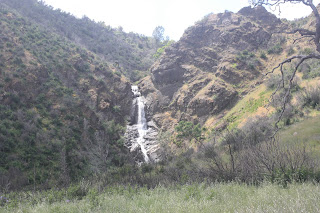 |
| Approaching the falls . . . |
There were a lot of interesting plants in this area, such as Diogenes' Lantern (Calochortus amabile, which translates to "lovable, beautiful grass"):
 |
| I'm hoping I can time a return visit to collect the mature seeds of these guys and some other flowers. |
The always-stunning Indian Paintbrush (Castilleja sp.):
 |
| New growth of Scrub Oak and a pretty little grass seedhead. |
 |
| Little stream lined with Seep Monkeyflower (Mimulus guttatus) and California Poppy (Eschschlolzia californica) |
Fringed Checkerbloom (Sidalcea diploscypha), a member of the mallow family, Malvaceae:
 |
| Yet another white morph of a flower that is typical a different color, a white Ithuriel's Spear (Triteleia laxa). |
 |
| Descending to the falls, I spotted this Checkerspot butterfly, not sure exactly what species (Euphydryas sp.) |
 |
| A lovely peach-colored species of Indian Paintbrush (Castilleja) |
 |
| I was scanning the area for a good lunch spot. Apparently, a squirrel found this rock a suitable place to enjoy some Grey Pine seeds. |
 |
| Yes, I think this spot will do just fine for my sandwich-consumption venue. |
 |
| Oh! Hello. |
Apparently the common name for this one is "Most Beautiful Jewelflower" (Streptanthus glandulosus ssp. glandulosus):
 |
| Western Spicebush (Calycanthus occidentalis) getting ready to bloom. Another in-"scent"-ive to revisit this hike soon! |
 |
| What's this funny little geophyte? I have no clue! |
 |
| I think this was the exact moment I got my poison oak rash on my arm, trying to get a photograph of this Bee Plant (Scrophularia californica) which lay on the other side of a thicket of the poison. This Scrophularia had really brilliant scarlet flowers. I have a scrophularia that I started from seed with different colored flowers growing very happily in my yard, and would love to gather some seeds from this specimen when they are mature. But I will have to be very careful if I do. |
Lunch time over, I began my ascent back up toward the main trail to start heading back.
There were some gorgeous Canyon Live-Forever (
Dudleya cymosa) in bloom, especially loving this rock outcropping:
On the same sunny slope adjacent to the falls, there was also Chaparral Clematis (Clematis lasiantha), a vining member of the Ranunculaceae family:
Back on the main trail and this quail sentry had his eye on me, making sure I didn't pose a threat to his "bevy" (that's the word for a group of quail--I just looked it up). Quail make me think of Grandma Williams. I think she had a particular fondness for them? Who couldn't, really--they are adorable!
Along the path there was a patch of Chia (Salvia columbariae), the seeds of which were used by indigenous people as a food source, to make porridge, mush, cakes, and many other things. Hopefully I can find some viable seed for these on a return trip. These specimens are all in the process of dehiscing (going to seed), so their actual flowers, which are a light blue/lavender color, have already fallen off:
 |
| Pincushion plant (Chaenactis sp.)? |
 |
| Chaenactis with Ithuriel's Spear |
 |
| Dainty little nightshade of some sort. |
 |
| I always look for this one Currant bush that is by the bank of Zim Zim Creek. It had just a couple little flowers on it this time. I love the fragrance of its leaves and have used them in brewing beer before. |
 |
| Longhorn Seablush (Plectritis macrocera) |
 |
| Unknown seedhead |
 |
| Sticky Cinquefoil (Drymocallis glandulosa), a member of the rose family, Rosaceae, like strawberries, which have similar-looking flowers. |
 |
| A species of Ceanothus in bloom near the trailhead. |
Well, that about wraps it up for this floral odyssey!
It was a spectacular day with many first-time plant identifications for me. It was extremely peaceful. I love immersing myself in nature and just soaking it all in, and I had a lot of fun photographing.
Like I mentioned, I hope to return in a couple weeks or so to see how things have changed, what is blooming as the season progresses and the soil dries out and things heat up more. And hopefully I can gather seed from some of the plants I saw blooming on this visit and try growing them at home.
Thanks for tuning in!
 |
| California Newt (Taricha torosa) puts one foot in front of the other. No slope is too steep to deter this little trailblazer. |


